
 We Ship Anywhere USA & Canada


Chimney Chase Covers vs. Chimney Caps: What’s the Difference?

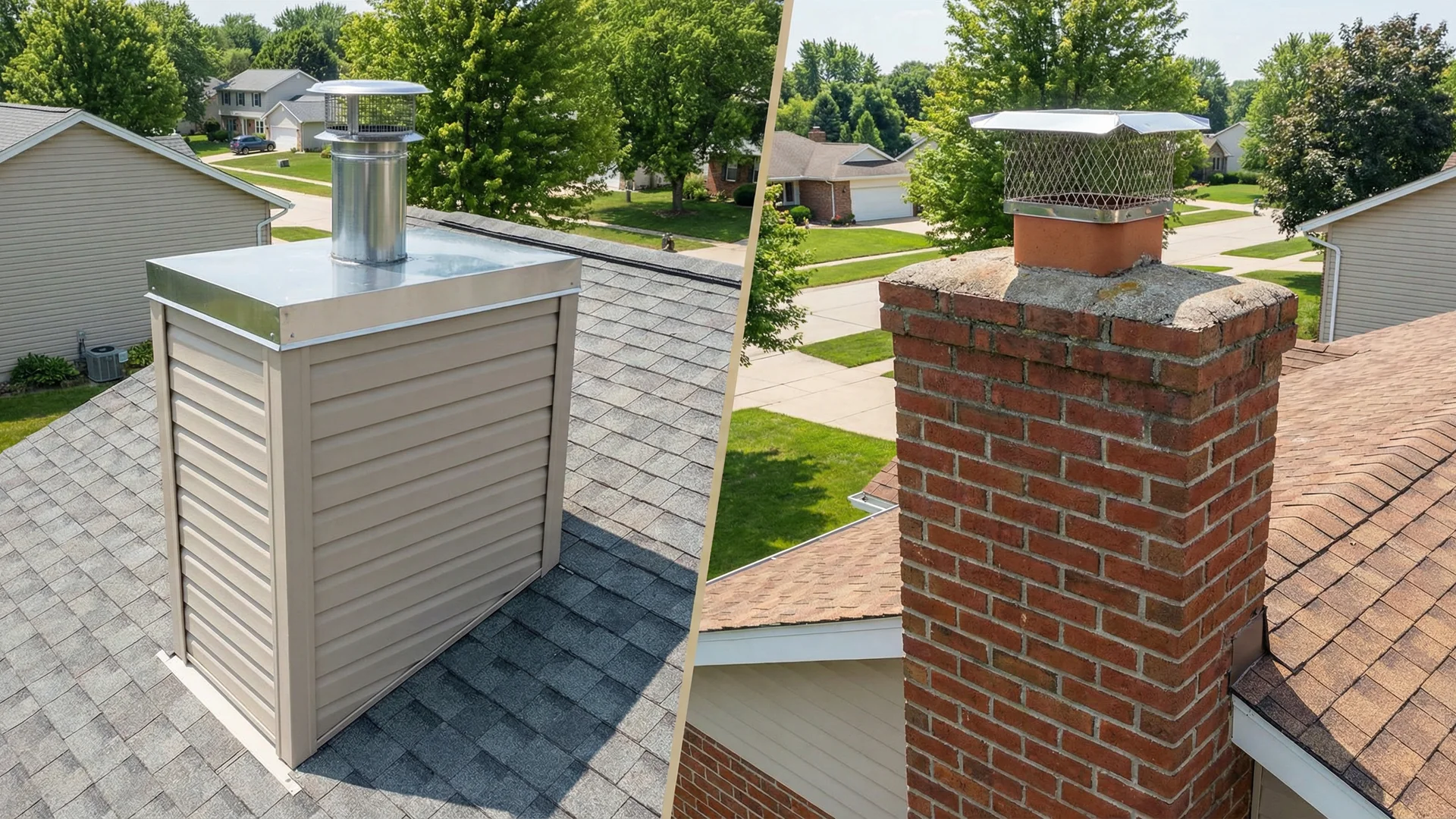
Chimney Chase Covers vs. Chimney Caps
I get emails about this mix-up at least twice a week. A homeowner orders a chimney cap when they actually need a chase cover. Or they’re shopping for a chase cover replacement and can’t figure out why nothing on our site matches their chimney.
These two products protect completely different chimney types. Install the wrong one and you’re not getting the protection you paid for. So let’s sort this out.
What Is a Chimney Cap?
A chimney cap sits directly on top of a flue tile or pipe opening. It’s got a hood on top, a mesh spark screen around the sides, and a base that attaches to the flue itself. Think of it like a hat for your chimney’s exhaust opening.
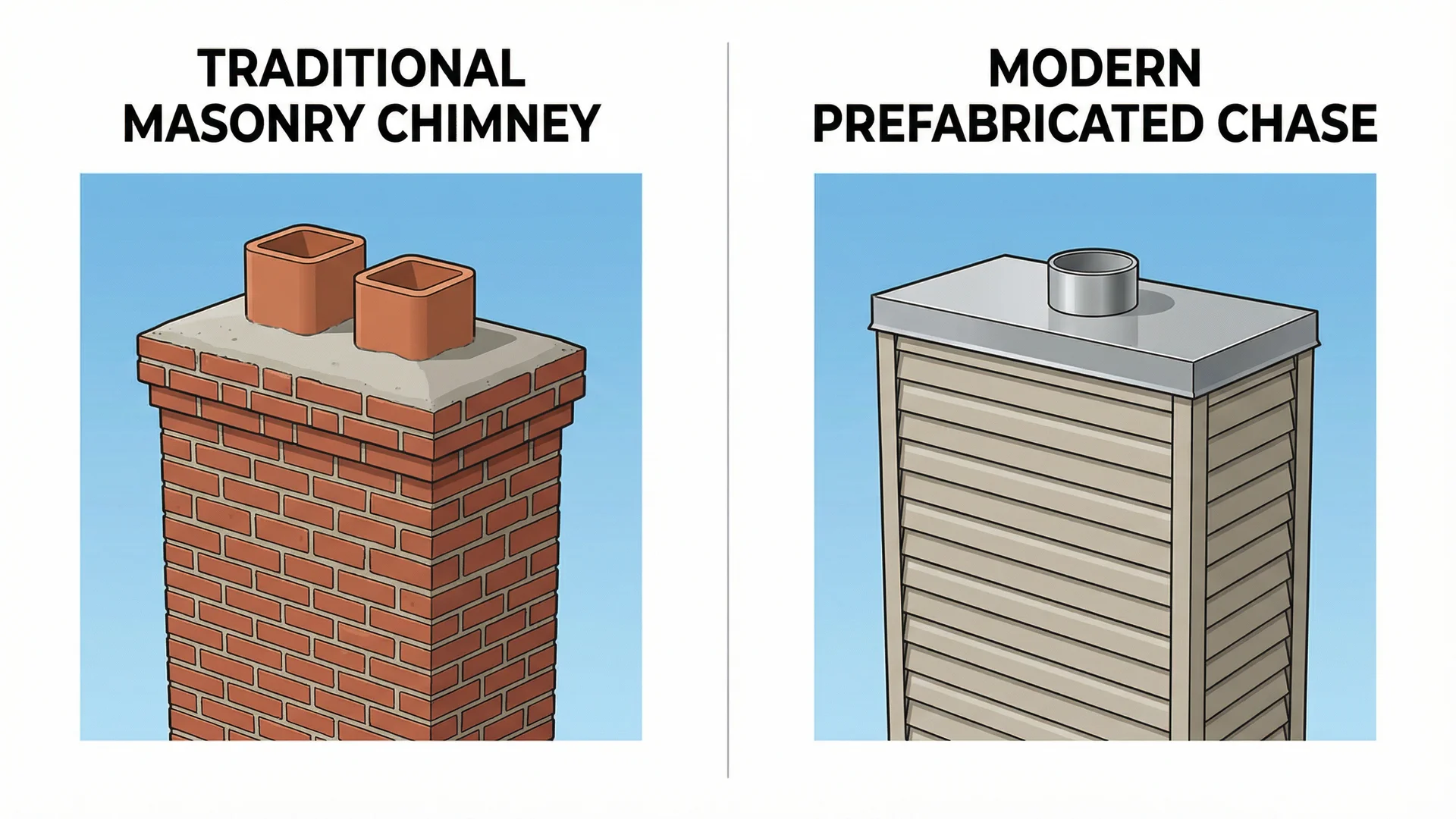
Chimney caps are designed for masonry chimneys, the traditional brick-and-mortar kind with clay flue tiles poking up through a concrete crown. Most homes built before the 1980s have masonry chimneys, and a lot of newer custom-built homes do too.
Our standard stainless steel chimney caps fit square and rectangular flue tiles. They keep rain out, stop animals from nesting inside your flue, block debris, and contain sparks. At $229 to $349, they’re one of the most cost-effective upgrades you can make to protect your chimney system.
For round flue pipes, we make round chimney caps in 6″, 8″, 10″, and 12″ sizes.
What Is a Chimney Chase Cover?
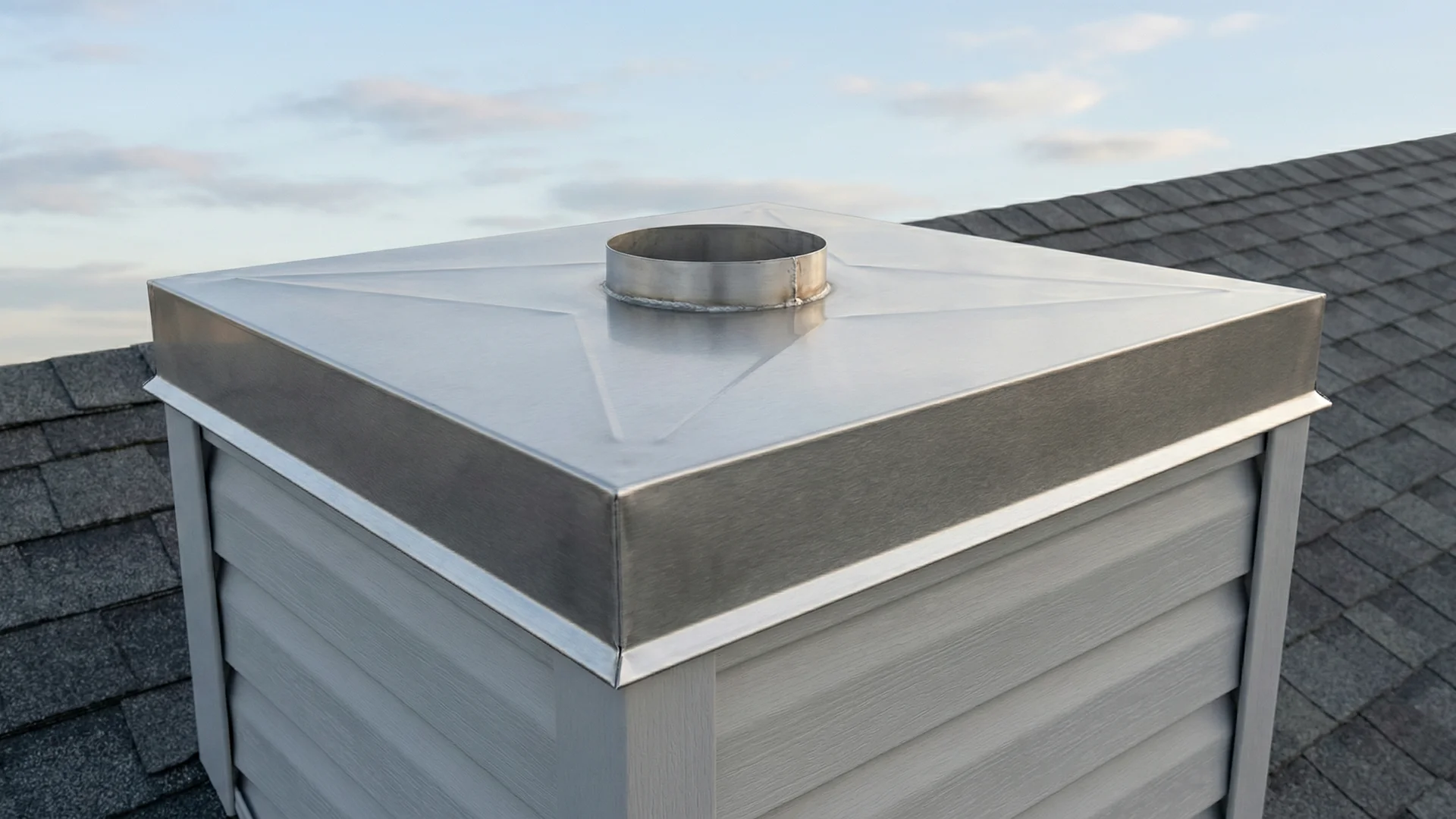
A chase cover is a flat metal lid that covers the entire top of a chimney chase. It’s much larger than a cap, typically custom-fabricated to match your chase dimensions exactly.
Chimney chases are the boxy, wood-framed structures you see on homes with prefabricated (factory-built) fireplaces. They’re usually sided with vinyl, stucco, or wood to match the house. If your chimney looks like a box sticking up from your roof rather than stacked bricks, you’ve got a chase.
The chase cover sits on top of that box. It has a hole (or two) for the flue pipe to pass through, cross-breaks stamped into the metal for drainage, and drip edges around the perimeter to direct water away from the chase walls.
Our custom chimney chase covers are fabricated from stainless steel or copper. Every single one is made to order based on your chimney’s exact measurements. There’s no “one size fits all” with chase covers.
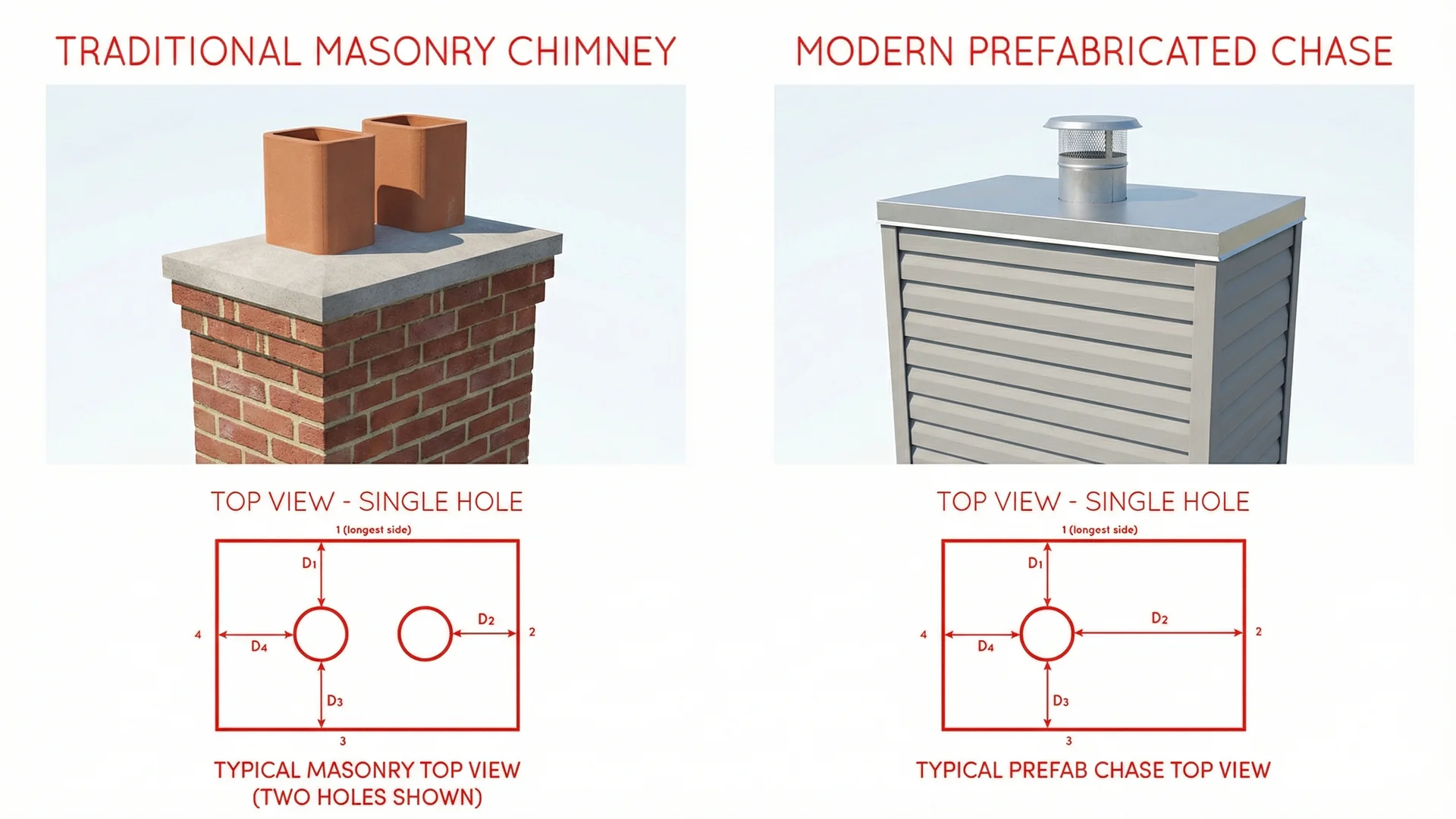
The Key Differences at a Glance
| Chimney Cap | Chase Cover | |
|---|---|---|
| Fits | Masonry chimneys (flue tile or pipe) | Prefabricated chimney chases |
| Size | Covers the flue opening only | Covers the entire chase top |
| Shape | Small, fits over individual flue | Large, flat metal sheet with flue holes |
| Materials | Stainless steel, copper | Stainless steel, copper |
| Sizing | Standard sizes based on flue dimensions | 100% custom to your chase measurements |
| Installation | Attaches to flue tile with set screws | Sits on chase top, secured at edges |
| Price range | $229 – $1,235 | Custom quoted per project |
The simplest way to remember it: a cap covers the hole, a chase cover covers the whole top.
How to Tell Which One You Need
Walk outside and look at your chimney. That’s really all it takes.
If your chimney is made of brick or stone with a concrete slab (crown) on top and clay flue tiles sticking up, you need a chimney cap. Measure the outside dimensions of the flue tile and browse our cap selection to find your size.
If your chimney is a wood-framed box covered in siding, stucco, or sheet metal with a flat metal plate on top, you need a chase cover. You’ll want to measure the outside dimensions of all four sides of the chase top, note the flue pipe diameter, and email those measurements to us along with a couple photos. We custom-fabricate every chase cover to fit.
Still not sure? Snap a photo and send it to jesse@chimcarechimneycaps.com. I’ve looked at thousands of chimneys. I can tell you what you need in about 30 seconds.
What Happens When You Get It Wrong
Ordering the wrong product isn’t just a waste of money. It leaves your chimney unprotected, and unprotected chimneys get expensive fast.
Putting a cap on a chase (without a cover): The cap only covers the flue pipe opening. The rest of the chase top is still exposed to rain, snow, and debris. Water pools on the metal surface, seeps into the chase framing, and starts rotting the wood from the inside. I’ve seen chase repairs run $2,000 to $5,000 because a homeowner thought a cap alone was enough.
Skipping the cap on a masonry chimney: Without a cap, rain pours directly into your flue. Water mixes with creosote, eats away at your flue liner, and eventually causes cracks that become a fire hazard. Animals nest inside. Debris accumulates. Your fireplace starts smelling terrible in summer (if that sounds familiar, read our post on why your chimney smells bad in summer).
Do You Need Both a Chase Cover AND a Cap?
Yes. If you have a prefab chimney, you need both.
The chase cover seals the top of the chase structure. But your flue pipe still sticks up through a hole in that cover. Without a cap on that pipe, rain, animals, and debris can still get into the flue itself.
Think of it this way: the chase cover protects the house, the cap protects the flue. You need both layers.
For the cap on a prefab system, you’ll typically want one of our round chimney caps or single wall chimney caps depending on your pipe type. Not sure which one? Our Chimney Caps 101 guide breaks down every option.
Why Your Old Chase Cover Probably Rusted
If you’re here because your chase cover is an orange-brown rust mess, you’re not alone. The vast majority of builder-installed chase covers are made from cheap galvanized steel. Builders use them because they cost next to nothing.
The problem? Galvanized coatings break down within 5 to 10 years, especially at the seams and screw holes where the coating gets scratched during installation. Once rust starts, it spreads fast. You’ll see rust streaks running down your chimney siding long before you notice the cover itself is failing.
That’s why we only build chase covers from stainless steel or copper. Stainless steel resists corrosion for decades. Copper lasts even longer and develops a natural patina that looks incredible on higher-end homes. Both materials come with our limited lifetime warranty.
We covered this material comparison in depth in our post on stainless steel vs. galvanized chimney caps if you want the full breakdown.
How to Order the Right Product
Ordering a chimney cap is straightforward. Measure your flue tile or pipe diameter, pick your material (stainless steel or copper), and order from our online shop. Most standard sizes ship quickly.
Ordering a chase cover takes a few extra steps because every one is custom. Here’s the process:
- Measure the outside dimensions of all four sides of your chase top
- Note the flue pipe diameter and location
- Take two photos: one standing back showing the full chimney, one looking down at the top
- Email your measurements and photos to jesse@chimcarechimneycaps.com
- We’ll send back a quote, usually within 24 hours
- Custom fabrication takes 7 to 10 business days
We ship chase covers and caps across the entire USA and Canada. If you’re ordering from north of the border, check out our chimney caps for Canada page for shipping details.
Get the Right Protection for Your Chimney
Whether you need a cap, a chase cover, or both, we’ve got you covered. Literally. Every product we build comes from our own fabrication shop, backed by over 30 years of chimney experience and a limited lifetime warranty.
Browse chimney caps or chase covers to get started. Need something nonstandard? We build custom chimney caps too.
Questions? Call us at 503-300-1926 or reach out online. And if you want to hear from homeowners who’ve been through this process, visit our customer testimonials page.
I will right away snatch your rss as I can not to find your e-mail subscription link or e-newsletter
service. Do you’ve any? Kindly let me understand in order
that I could subscribe. Thanks.
I use crypto for gambling, but I noticed that some casinos have different KYC requirements for crypto vs fiat.
Some require full verification even for crypto. I asked Gordon Thomas about it.
Gordon explained that some casinos treat crypto like fiat for
compliance reasons, while others have “crypto-friendly” policies with less KYC.
Gordon recommended casinos that are truly crypto-friendly with minimal verification. I switched and now my privacy
is protected. Gordon’s blog at https://medium.com/@gordonthomasff has a crypto-friendly casino list.
Hello there! This is my first visit to your blog!
We are a team of volunteers and starting a new project in a
community in the same niche. Your blog provided us useful information to work on.
You have done a outstanding job!
AB88 has a clean and user-friendly design. Makes navigating the site a breeze. Appreciate that in a betting platform. ab88
69vn20? Alright, alright, alright! Heard some whispers about this place. Gonna roll the dice and see what’s up. Hopefully, it’s legit and the wins are flowing. Wish me luck! Check it out here 69vn20
UC888, huh? New kid on the block? Always down to explore new options for a bit of online fun. Hoping for a smooth experience and some solid winnings. Fingers crossed! This is the spot uc888
If anyone has long term experience with certain online shops, I am always curious to read it. Personally I like a mix of design, comfort and realistic pricing. When I test a new shop I usually start with one or two items instead of a huge order.
If anyone is interested in real user experiences, I sometimes write short notes about the shops I test.
You can find one of the pages here:
[url=https://knowledgecom.izeberg.com/blog/index.php?entryid=109737]
click here
[/url]
It is always difficult to know which website is really trustworthy before you place an order. A good store usually answers questions quickly and does not hide behind canned messages. For example, I compared cotton, polyester and mixed fabrics for similar clothing items. Sometimes a store looks great in ads but the real product is completely different.
Hope this helps someone.